





- Work with a right answer goes to software. Work that needs judgment stays with a person. A person checks every software result.
- The tasks bookkeeper postings ask for most are exactly the ones with a right answer: bank reconciliation (102 of 125), bills (98) and invoicing (91).
- So the seat does not go away. It gets smaller, and the person in it spends their hours on the parts that need them.
The rule: a right answer goes to software
Software agents are good at one kind of work: the kind with a right answer. A bank line either matches an invoice or it does not. A bill is coded to the account it was coded to last month, or it is flagged. That is most of the routine in a bookkeeping seat.
A software agent does the task end to end in your own software. It does not suggest an entry and wait. It enters it, and then a person checks it.
What bookkeeper postings ask for, and who takes it
| Task in the posting | Postings that list it | Who takes it |
|---|---|---|
| Bank and card reconciliation | 102 of 125 | agents Agents match every line. Your person clears what is left. |
| Bills: enter, code, pay | 98 of 125 | agents Agents read and enter bills. Nothing pays out until your person approves. |
| Invoicing and billing | 91 of 125 | agents Agents send invoices and match payments to them. |
| Payroll | 84 of 125 | agentsperson Your person runs payroll in your payroll system. Agents keep the records in the books. |
| Financial statements and reports | 80 of 125 | agentsperson Agents draft them. Your person checks and sends them by the 10th. |
| Journal entries | 76 of 125 | agentsperson Agents draft the routine ones. Your person reviews and posts them. |
| Categorizing transactions | 51 of 125 | agents Agents code each line the way it was coded last time, and flag the new ones. |
| Month-end close | 47 of 125 | agentsperson Agents do the matching and the entries. Your person closes and signs off. |
| Audit prep | 37 of 125 | agentsperson Agents gather the documents. Your person answers the auditor. |
| Collections follow-up | 33 of 125 | agents Agents send polite reminders. Your person handles the conversation. |
| Office, admin and HR duties | 33 of 125 | not ours Not ours. If it needs the building, it stays in the building. |
| Sales and use tax | 20 of 125 | agentsperson Agents prepare the figures. Your person files. |
What it looks like: one bill, start to finish
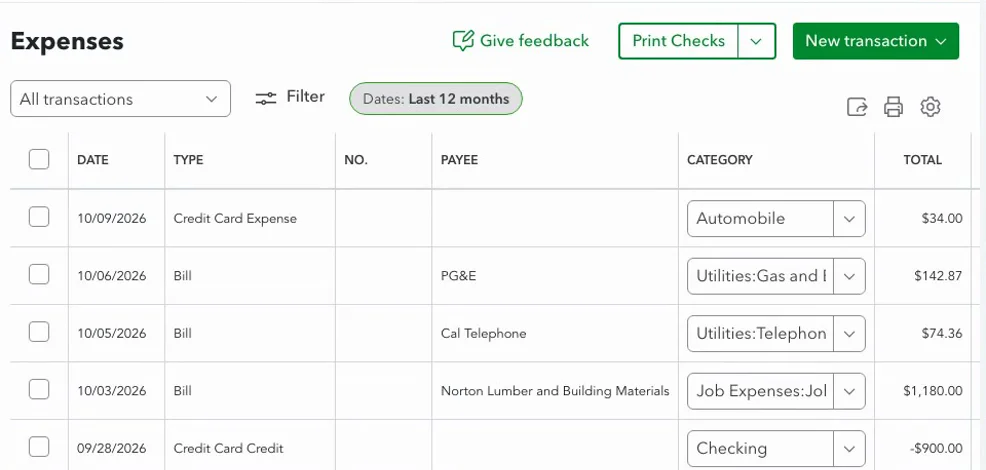
- agentsThe agent picks up a new bill PDF from the accounts inbox.
- agentsThe agent reads the vendor, amount, date and due date, and enters the bill in your QuickBooks.
- agentsIt codes the bill to the account this vendor's bills went to last time. A new vendor or an odd amount gets flagged instead.
- personYour person checks the entry and clears anything flagged.
- personOn the due date, your person releases the payment. Nothing pays out without a person.
What stays with a person
- Month-end close and sign-off
- Anything unusual the agents flag
- Releasing payments
- Judgment calls: accruals, write-offs, how to treat something new
- Your questions, and the conversations with customers and vendors
What software cannot do yet
Be wary of anyone who says it does all of it. Today the agents do not make judgment calls, do not talk to your customers about a dispute, and do not handle anything physical. Some systems, including most payroll and HR software, only let approved partners connect; your person works in those like any employee. The list of what the agents reach is on software we work in.
How the split changes over time
The agents learn from every fix your person makes, so the routine share they carry grows. The hours a person spends on routine work go down.
An illustration of the direction, not a forecast. Your real numbers come from the task list in your own posting.
With a dedicated person, hours the agents take come off your bill that month. That is the hours buyback. Either way, an hours report shows who did what every month.
The rule that makes it safe
A person checks every agent result before it reaches you. The agents do the work; the person owns the books. Anything that moves money waits for a person to approve it. That is why there is still a named person on the seat.
Questions owners ask
Will the agents make mistakes?
Sometimes, which is why a person checks every result before it reaches you. In week 2 the agents run next to your current process, so anything they get wrong shows up in days, not at month-end.
Do the agents post anything without a person?
They enter and code the routine work in your software. Anything that moves money waits for a person to approve it, and your person checks the entries before the month is closed.
Is our data used to train the agents?
No. Your data is never used to train anything and never combined with another client's.
Do we have to change software?
No. The agents work in your own QuickBooks, Xero, NetSuite or Odoo, set up the way it is today. See software we work in.
Then why not just buy software and skip the person?
Because someone still has to check the work, make the judgment calls and close the month. Software without an owner is how books drift. The person is the owner.
See your own seat sorted into the two columns.
Pick the role and leave your work email. We find your posting and mark every duty: done by software from day one, done by the person, or not ours.
Sources: task counts from our full read of 125 US bookkeeper postings (September 2026). The month 1, 6 and 12 split is an illustration. Key terms: